
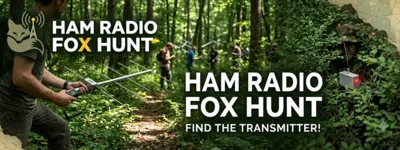
Fox Hunting & Amateur Radio Direction Finding (ARDF)
Welcome to the ultimate live-action radio hide-and-seek. “Fox Hunting” (internationally known as Amateur Radio Direction Finding, or ARDF) is a competitive sport that combines map-reading, orienteering, and radio engineering.
The game is simple: a low-power, automated miniature transmitter (the “Fox”) is hidden somewhere inside a local park or community woodland, broadcasting short, periodic signals. Operators equipped with directional handheld antennas and signal attenuators track the hidden signal, triangulate its position, and hunt it down on foot against the clock.
🧭 Regional Club Hunts & Community Tracking
Our club runs regular, family-friendly Fox Hunts throughout the year, often centering operations in shaded community parks to beat the summer heat. These events are open to licensed hams and curious newcomers alike!
- Primary Hunting Frequency: Typically hosted on the 2-Meter band near
146.565 MHz(Simplex). - Loaner Gear Availability: The club maintains a fleet of loaner directional antennas and attenuators for guests and youth participants.
🎯 The Triangulation Method
Hunting a hidden transmitter requires mastering a mix of hardware manipulation and geometric navigation:
- The Directional Antenna: Using a highly directional handheld antenna, like a 3-element Yagi, hunters sweep the horizon. The signal will get noticeably louder (or show a higher reading on a signal strength meter) when pointing directly at the hidden Fox.
- Signal Attenuation: As you walk closer to the hidden transmitter, the signal becomes so overwhelmingly strong that it will flood your radio’s receiver, making it sound loud in every direction. Hunters deploy resistive inline hardware units (“attenuators”) to intentionally weaken the incoming signal, keeping the directional bearings sharp even when standing just yards away from the hidden device.
📂 Blueprints & DIY Antenna Build Guides
You don’t need expensive commercial gear to win a Fox Hunt! In fact, the most competitive antennas used by our club champions are homebuilt in an afternoon using less than $15 of basic hardware store supplies:
- 🛠️ The DIY Tape Measure Yagi Antenna Guide — The gold standard homebrew project. Uses a PVC cross-joint and steel building tape-measure blades to build a highly durable, flexible directional antenna.
- 💾 Active Attenuator Kit Project — A simple, beginner-friendly electronic soldering kit project to build a variable offset attenuator for close-in tracking.
- 🌐 International ARDF Rules & Layouts — Learn the global competitive sport guidelines, signal timing structures, and map marking protocols.
🎓 How to Join the Next Hunt with Zero Gear
Fox Hunting is completely passive—meaning you are only receiving radio waves, not transmitting. Because of this, no FCC amateur radio license is required to participate! It is the absolute perfect entry point for kids, grandkids, and neighbors to experience the real-world physics of radio waves firsthand.
- 📡 Bring Any Handheld Scanner: If you own a cheap analog police scanner or an un-programmed dual-band handheld transceiver, you can lock in the hunt frequency and follow along with the field units.
- 🦊 The “Body Shield” Trick: If you don’t have a directional antenna yet, you can hold a standard rubber-duck antenna radio close to your chest and slowly rotate 360 degrees. Your body acts as a natural signal shield. When the signal drops to its weakest point (“the null”), the hidden transmitter is directly behind your back!
🤝 Track Down the Next Launch Block
Ready to test your navigation skills against our hidden automated beacons? Our hunts are usually held on Saturday mornings and conclude with a casual club social or lunch. Check our master homepage itinerary desk to view the next designated park staging point, and come out to join the hunt!