
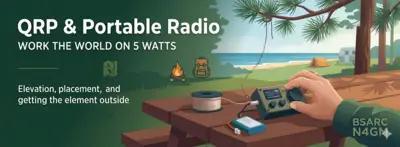
Introduction to QRP: The Art of Low-Power Radio
In the amateur radio world, “QRP” is the universal Q-code designation for reducing your transmitter power. By general agreement, operating QRP means transmitting at 5 Watts or less on CW (Morse Code) and digital modes, or 10 Watts or less on SSB Voice.
While it might sound crazy to newcomers to intentionally limit their signal strength, QRP has become one of the most popular, addictive, and fast-growing ecosystems in the entire hobby. It shifts the game away from raw mechanical muscle and transforms radio operations into a sport of pure skill, engineering efficiency, and portable adventure.
🎒 Why Choose the QRP Lifestyle?
- True Portability: QRP rigs are incredibly compact. Because they draw very little current, you don’t need a heavy 20-pound lead-acid battery to run them. A tiny lithium iron phosphate (LiFePO4) battery pack can power a QRP station in the field for an entire weekend.
- The POTA & SOTA Boom: Parks on the Air (POTA) and Summits on the Air (SOTA) have revolutionized the hobby. QRP stations are the ultimate field-day weapon—allowing you to rapidly deploy a worldwide station from a park picnic table, a beach trunk layout, or a mountain peak.
- Budget-Friendly Innovation: Because you are dealing with low-power circuitry, high-performance QRP kits and radios are significantly less expensive than traditional 100W base stations, offering a highly accessible entry point to true HF building.
📻 Legendary QRP Rigs: From Kits to Commercial Workhorses
If you are looking to assemble a portable backpack station, the market features brilliant options ranging from pocket-sized CW trail rigs to multi-mode tactical setups:
1. QRP-Labs (The King of Budget Innovation)
Known for their legendary kits like the QCX and the multi-band QMX / QDX series. QRP-Labs has revolutionized low-power operations by providing ultra-high-performance, software-defined digital and CW transceivers for a fraction of the cost of big-box manufacturers. They are incredibly popular for building tiny, dedicated high-efficiency FT8 data or Morse stations.
2. LNR Precision Mountain Topper (The Ultimate Trail Rig)
If you want to pack light for a true wilderness hike, the Mountain Topper (MTR) series is legendary. These micro-sized, multi-band CW rigs are about the size of a deck of playing cards and weigh mere ounces. They run on minimal battery power and are highly prized by extreme outdoor backpackers who need rugged reliability where every ounce counts.
3. Yaesu FT-817 / FT-818ND (The Swiss Army Knife)
While officially discontinued, the legendary Yaesu FT-817 and FT-818ND remain the ultimate gold-standard reference points for multi-mode portable adventure. Pushing a clean 5 to 6 watts, this all-in-one legendary footprint covers HF, VHF, and UHF bands out of a single compact brick chassis. It can run on internal batteries, supports SSB voice, CW, and digital data, and remains a prized companion for portable field operators who want zero band limitations.
📈 The Three Commandments of Successful QRP
Operating low power means you cannot brute-force your way through bad physics. To succeed where a 100-watt station struggles, you must optimize the rest of your station environment:
- The Antenna is Everything: When running 5 watts, every single decibel counts. Ditch the indoor compromise antennas. You need a highly efficient, resonant outdoor wire array—like a full-sized center-fed dipole or an End-Fed Half-Wave (EFHW) thrown high into a clean tree branch. Elevation and resonance are your secret multipliers.
- Master Weak-Signal Digital Modes: If you aren’t comfortable with Morse Code (CW) yet, don’t worry! Running 5 watts into digital weak-signal modes like FT8 or FT4 will easily let you work every continent on earth. The software can decode digital pings that are completely buried deep below the audible noise floor.
- Patience & Timing: You have to operate like a sniper, not a machine gunner. Instead of calling CQ endlessly into a crowded band, hunt for strong stations, learn to time your calls perfectly at the tail end of an exchange, and leverage peak solar propagation cycles to let the ionosphere do the heavy lifting for you.
🤝 The BSARC Portable Group: Want to see these tiny rigs in action before you buy one? Come out to our next club field event or weekend park activation! Our members regularly deploy QRP setups, throw lines into trees, and run digital data traps right from the field. It’s the best way to get hands-on experience with portable battery management and wire deployments.